


This article reflects market conditions and commentary presented during AllGen Financial’s Quarterly Market Update on July 16, 2026.
U.S. stocks have remained resilient despite geopolitical conflict, changing oil prices and uncertainty surrounding inflation and interest rates. At the same time, higher valuations in some of the largest U.S. companies, rapid growth in artificial intelligence investments and the possibility of greater market volatility make diversification and disciplined risk management especially important.
Key Takeaways from the Q3 2026 Market Update
- Market leadership has broadened beyond the largest U.S. companies, with small-cap and international stocks showing renewed strength.
- Oil prices remain an important economic indicator because energy costs can influence inflation, consumer spending and interest-rate expectations.
- Investor and consumer sentiment can be useful contrarian indicators, especially when optimism or pessimism reaches an extreme.
- U.S. large-cap valuations remain elevated, but other market segments may offer more reasonable valuations.
- Artificial intelligence is supporting investment, productivity and earnings growth, although rapidly rising AI-related stocks also carry greater valuation risk.
- Gold, commodities and international investments remain closely connected to the direction of the U.S. dollar.
- A potentially weaker seasonal period could create short-term volatility, but volatility alone is not a reason to abandon a long-term investment strategy.
- Municipal bonds may provide attractive after-tax income for certain investors with taxable accounts.
How Have the Markets Performed So Far in 2026?
The first half of 2026 demonstrated why investors should avoid relying on a single asset class.
The webinar’s year-to-date market snapshot showed meaningful differences between areas of the investment landscape. Small-cap stocks, which had struggled relative to larger companies for much of the previous decade, emerged as one of the stronger performers. International stocks also continued to compete with the U.S. market.
The S&P 500 remained positive and close to its previous highs, while the broad bond market was approximately flat. Gold, after beginning the year strongly, experienced a notable pullback as the U.S. dollar strengthened. This variation reinforces an important principle: diversification is not simply about owning more investments. It is about owning investments that respond differently to changing economic conditions.
Year-to-Date Market Performance
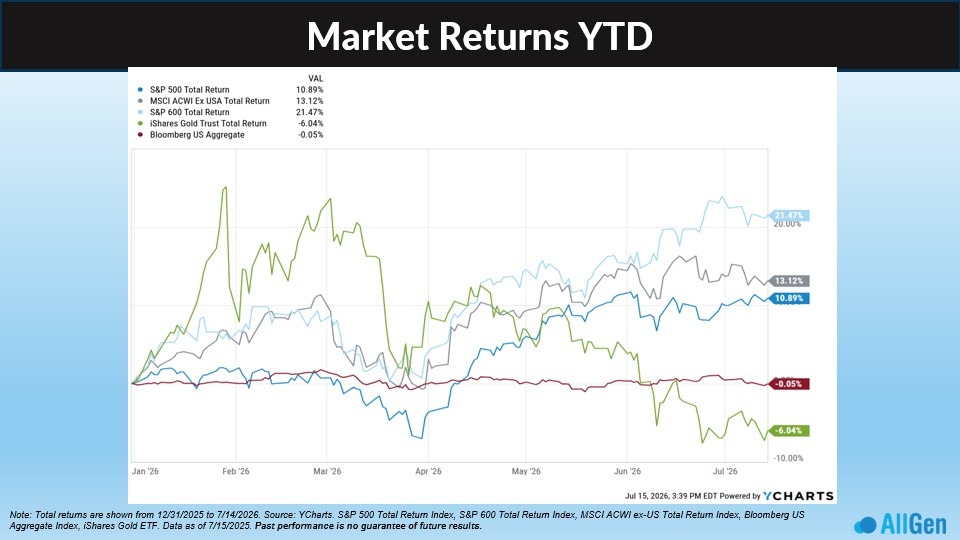
Caption: Market performance varied significantly across asset classes during the first half of 2026.
Investors who concentrated exclusively in the previous market leaders may have missed opportunities elsewhere. A diversified portfolio can participate when leadership broadens while reducing dependence on any one company, sector or country.
Why Oil Prices Remain Important to Investors
Geopolitical developments in the Middle East have placed renewed attention on oil production and transportation through the Strait of Hormuz.
A significant portion of the world’s oil supply traditionally travels through this region. When shipping activity is disrupted, or investors believe future supplies could be disrupted, oil prices can move sharply.
The presentation illustrated how oil prices increased when the conflict intensified, declined as shipping conditions and ceasefire expectations improved, and then began rising again when tensions returned.
Oil Prices and Geopolitical Conflict
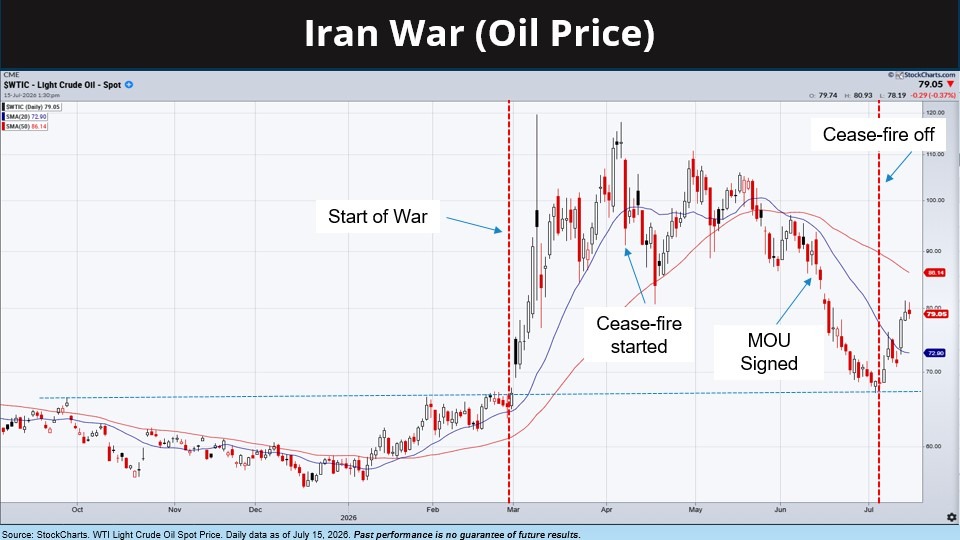
Caption: Oil prices reacted quickly as geopolitical conditions and expectations for future supplies changed.
Oil matters for more than the price consumers pay at the gas pump. Higher energy costs can affect:
- Transportation and shipping expenses
- Manufacturing and production costs
- Restaurant and food prices
- Household discretionary spending
- Inflation expectations
- Federal Reserve policy
- Bond yields and borrowing costs
The flow of vessels through the Strait of Hormuz therefore became an important indicator during the quarter. An increase in vessel traffic suggested that more energy supplies could reach global markets. A reduction in traffic created renewed concerns about availability and prices.
Vessel Crossings Through the Strait of Hormuz
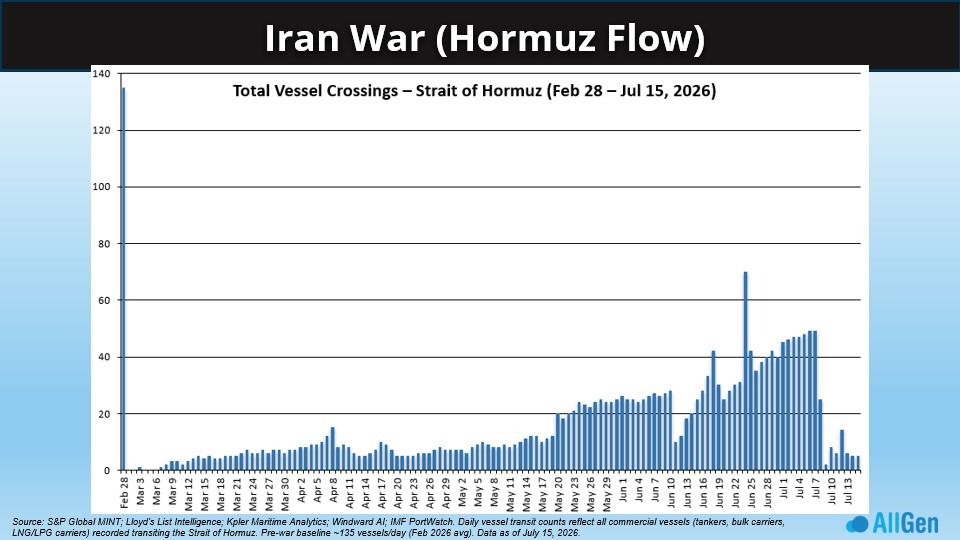
Caption: Shipping activity through the Strait of Hormuz provided insight into potential changes in global energy supplies.
Other producers, transportation routes and planned pipeline capacity may help reduce the world’s reliance on a single shipping channel. Oil demand can also change as economic activity accelerates or slows. For that reason, investors should avoid drawing conclusions from one headline or one day of price movements.
The broader trend and the potential effect on inflation matters more.
What Can Investor Sentiment Tell Us About the Market?
Investor sentiment measures how optimistic or pessimistic market participants feel.
It may seem logical to invest more when everyone feels confident and reduce investments when everyone feels afraid. Historically, however, emotional extremes have frequently produced the opposite result.
When optimism becomes excessive, investors likely are holding investments that have already gone up, leaving the market more vulnerable to disappointing news. When pessimism becomes extreme, prices may already reflect a significant amount of negative information.
This is why sentiment is often used as a contrarian indicator.
Investor Sentiment and the S&P 500
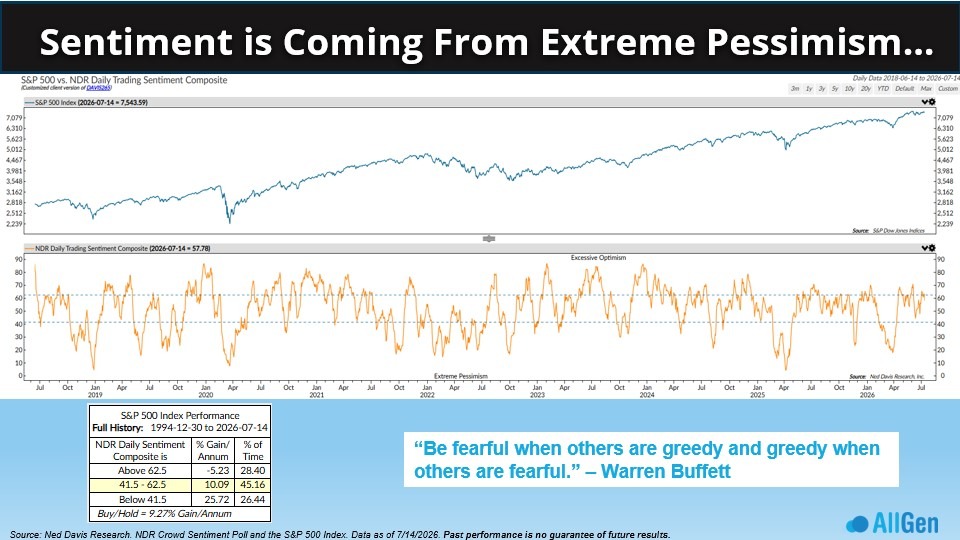
Caption: Extremely positive or negative investor sentiment can provide useful context when evaluating market risk.
Investor sentiment had recently moved away from excessive optimism and was closer to a neutral level. Neutral sentiment does not provide the same strong contrarian signal as an extreme, but it can indicate that investors are neither universally enthusiastic nor universally fearful.
Consumer sentiment told a somewhat different story. Consumers remained historically discouraged about the economy and the cost of living. Although weak consumer confidence may feel like a negative market signal, previous periods of deeply pessimistic sentiment have often been followed by stronger market returns.
Past performance cannot predict future results, and every economic period is different. The practical lesson is not to invest automatically whenever people feel discouraged. It is to recognize that your emotional reaction to current events may be a poor indicator of what markets will do next. Before making a major investment change, consider asking:
- Has my financial situation changed?
- Have my goals or time horizon changed?
- Is my portfolio taking more risk than my plan allows?
- Am I reacting to evidence or to fear?
Are U.S. Stocks Overvalued?
Valuation measures the price investors are paying in relation to a company’s earnings, cash flow, assets or other financial characteristics. The forward price-to-earnings ratio for the S&P 500 remained above its longer-term average. Other valuation measures also indicated that large U.S. stocks were relatively expensive compared with their own history.
That does not mean the market must immediately decline. Valuations tend to be more useful when estimating longer-term return potential than when predicting what will happen over the next several weeks or months. Expensive markets can remain expensive and continue rising for an extended period. More importantly, “the market” is not one uniform investment.
U.S. Equity Valuations by Market Segment
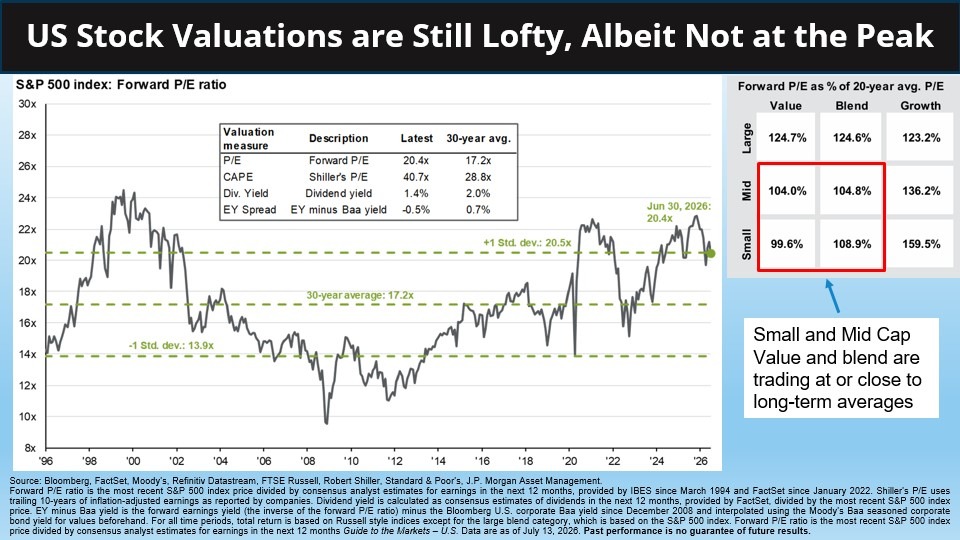
Caption: While large U.S. stocks remained expensive, several smaller-company and value-oriented segments were closer to historical valuations.
Small- and mid-sized companies were trading closer to their historical averages. Certain value-oriented areas also appeared less expensive than large growth companies. This creates an environment in which portfolio construction may matter more than simply deciding whether to be “in” or “out” of the stock market.
Investors may benefit from reviewing:
- Exposure to highly valued large companies
- Concentration in a small number of technology stocks
- Small- and mid-cap allocations
- Value and growth diversification
- International exposure
- The relationship between portfolio risk and financial goals
How Is Artificial Intelligence Affecting the Stock Market?
One reason the market has remained resilient is the continued strength of corporate earnings and profit margins. Companies have become more efficient, and many are investing heavily in artificial intelligence, data centers, semiconductor capacity and cloud infrastructure. AI-enabled productivity is one possible contributor to improving margins: employees and businesses can complete more work in less time, potentially lowering costs or supporting higher output.
AI Capital Expenditures and Free Cash Flow
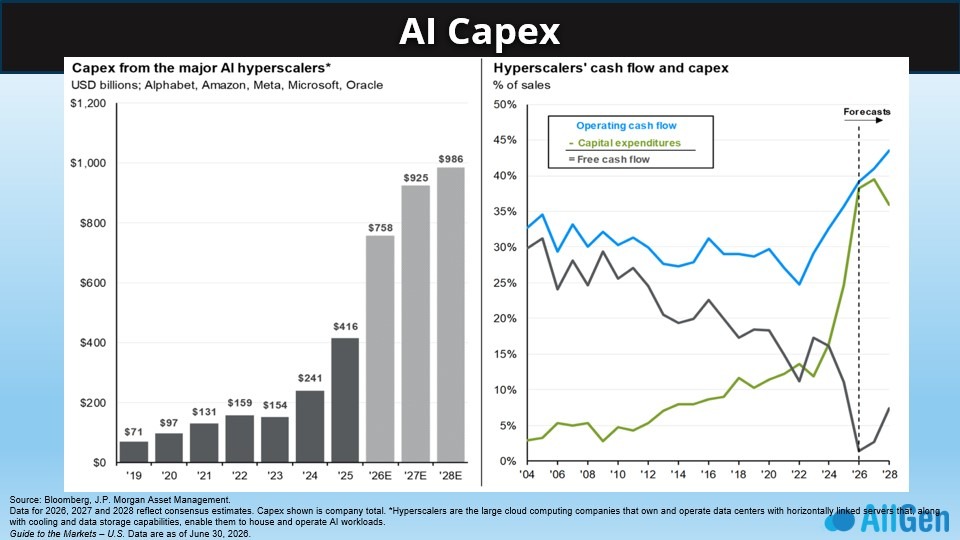
Caption: Major technology companies are committing a growing share of their resources to AI infrastructure and future capacity.
Large technology companies are directing substantial capital toward building the infrastructure needed to support AI. That spending can benefit semiconductor manufacturers, data-center operators, utilities, software companies and other businesses throughout the AI ecosystem.
However, rapid growth can create risk. Some AI-related and semiconductor stocks have risen dramatically. When prices increase much faster than the underlying business fundamentals, future returns become more dependent on exceptionally strong expectations being met.
This does not necessarily mean every AI stock is in a bubble or that investors should abandon the sector. AI may represent a long-term technological transformation. Nevertheless, higher valuations typically mean:
- Greater sensitivity to disappointing earnings
- More severe reactions to changing expectations
- Increased concentration risk
- A greater need for disciplined rebalancing
- Less margin for error
- Taking partial profits or rebalancing an oversized position does not require an investor to believe that the investment will fail. It is a way to prevent one successful holding from creating an unintended level of portfolio risk.
What Do the Dollar, Gold and Commodities Mean for Diversification?
The U.S. dollar influences many areas of the global investment landscape.
A stronger dollar can create challenges for gold, commodities and international investments when their returns are measured in U.S. dollars. A weaker dollar can provide support to those same areas.
During the first half of 2026, the dollar strengthened after testing its longer-term trend. Gold moved in the opposite direction and gave back some of its earlier gains.
Although gold experienced short-term weakness, the presentation noted that the longer-term trend had not necessarily been broken. Central banks around the world have also been increasing the role of gold within their reserve assets, providing a fundamental source of demand. Commodities more broadly, such as energy, metals and agricultural products, have shown periods of renewed strength relative to U.S. stocks.
Commodities Relative to the S&P 500
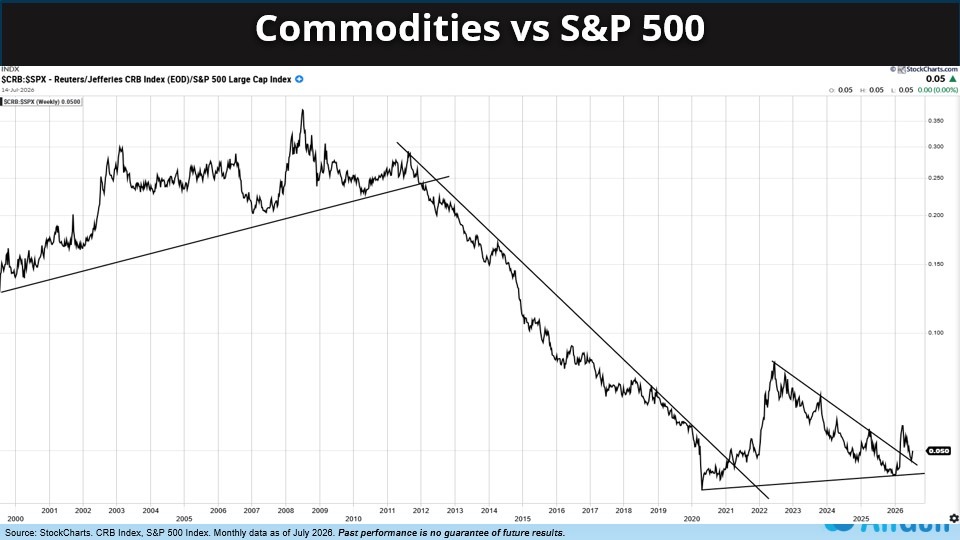
Caption: Commodities and U.S. stocks can experience extended periods of alternating market leadership.
Commodities may provide another source of diversification, particularly during periods involving:
- Higher inflation
- Supply constraints
- Rising geopolitical risk
- A weakening dollar
- Simultaneous pressure on stocks and bonds
The same principle applies to international and emerging-market investments. Those markets may offer more reasonable valuations than large U.S. stocks, but their performance can be heavily influenced by currencies, global trade and the direction of the dollar. The appropriate allocation depends on the investor’s goals, time horizon, tax circumstances and ability to tolerate volatility.
Could the Market Become More Volatile During Q3?
Market cycles and seasonal patterns suggest that the late-summer and early-fall period can be more challenging than other parts of the year.
The “S&P 500 2026 Cyclical Chart” combined the average one-year market cycle, the four-year presidential cycle and the 10-year decennial cycle. Together, those historical patterns suggested the possibility of weaker market conditions between the summer and approximately October.
Presidential and Decennial Market Cycles
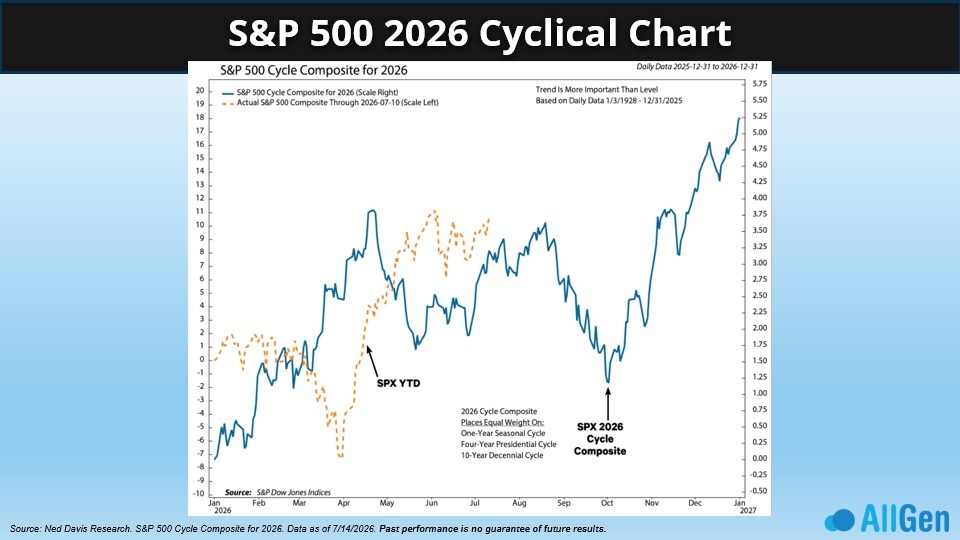
Caption: Historical cycles suggest that late summer and early fall can bring additional market volatility.
Seasonality is not a forecast. Markets do not have to follow their historical patterns, and investment decisions should never be based on the calendar alone. When seasonal risk is considered alongside elevated valuations and geopolitical uncertainty, it may support a somewhat more cautious portfolio posture. That could include:
- Rebalancing appreciated positions
- Reducing unintended concentration
- Maintaining appropriate liquidity
- Reviewing downside risk
- Preserving the ability to invest during a pullback
A defensive adjustment is different from leaving the market completely. Market declines may eventually create opportunities to add investments at more attractive prices. The goal is not to avoid every decline. The goal is to ensure that a temporary decline does not prevent you from achieving a long-term objective.
What Is the Outlook for Inflation and Interest Rates?
Inflation remains central to the outlook for both stocks and bonds.
The “Contributors to headline CPI inflation” chart showed that energy was a major contributor to the recent increase in inflation. Unlike some forms of inflation, energy inflation can change relatively quickly. Oil prices can rise sharply when supplies are disrupted and fall when production, transportation or demand conditions improve. Wage inflation, by comparison, tends to be more persistent. Once compensation increases are built into business expenses, they can take longer to reverse.
Components of Consumer Price Inflation
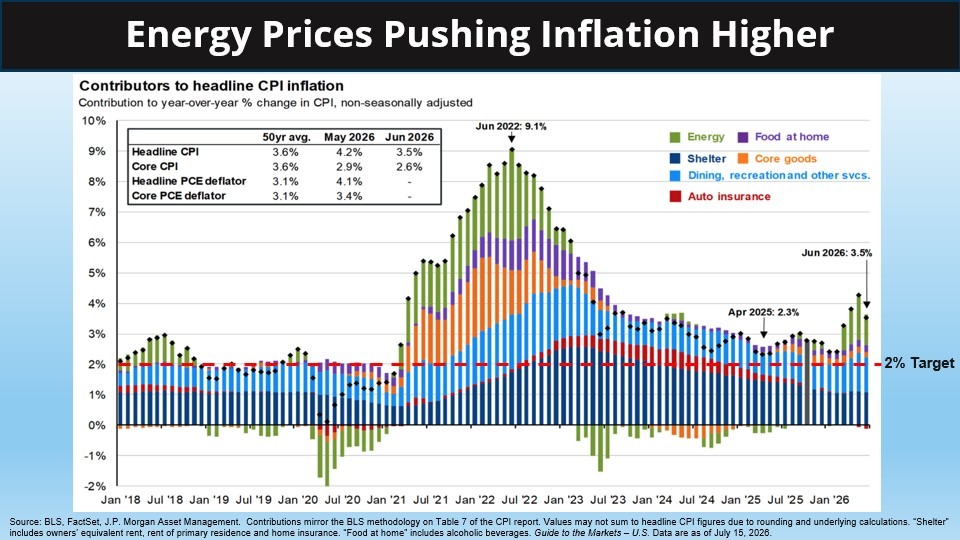
Caption: Understanding which categories are driving inflation can help investors evaluate whether higher prices may be temporary or persistent.
Inflation influences the Federal Reserve’s interest-rate decisions. If inflation remains elevated or begins increasing, policymakers may be more likely to maintain or raise rates. If inflation moves lower, the pressure for restrictive policy may decrease.
Long-term Treasury yields are also important. Rising yields can reduce the value of existing long-term bonds, while falling yields can support their prices. This is why bond duration (the sensitivity of a bond portfolio to changing interest rates) requires active attention. A portfolio may favor shorter-term or floating-rate investments when rates are rising and extend duration when the probability of falling rates becomes more convincing.
Why Municipal Bonds May Be Attractive in Taxable Accounts
Municipal bonds generally pay interest that is exempt from federal income tax, although the tax treatment can vary by investment and investor. Because of that tax advantage, a municipal bond with a lower stated yield may produce more spendable after-tax income than a taxable bond with a higher stated yield.
Municipal Bonds and Taxable Bonds After Taxes
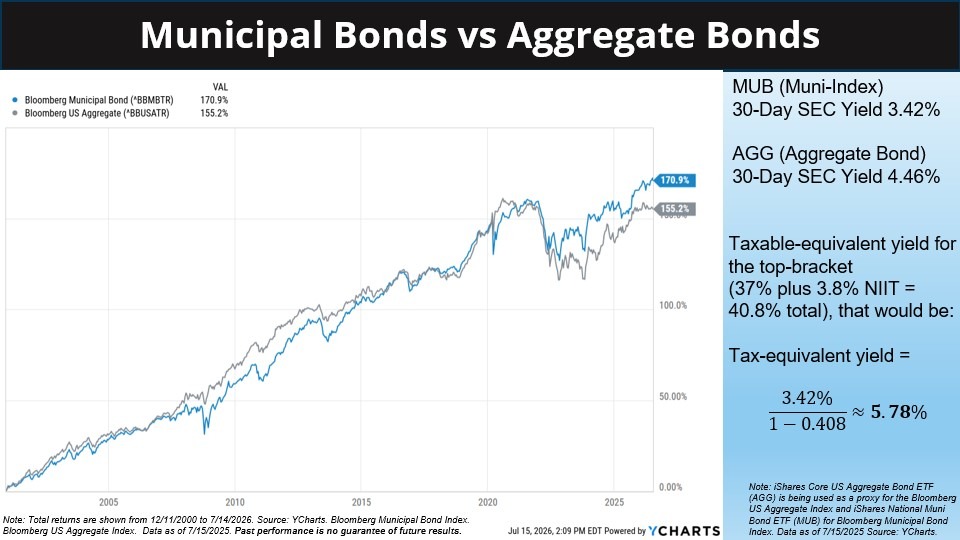
Caption: The value of tax-exempt municipal income depends on an investor’s marginal tax rate and account type.
Municipal bonds may be particularly relevant for investors who:
- Hold fixed-income investments in taxable accounts
- Are subject to higher marginal tax rates
- Need portfolio income
- Want to reduce exposure to longer-duration taxable bonds
- Are coordinating investment decisions with tax planning
- Municipal bonds still carry risks, including interest-rate, credit, liquidity and market risks. Their appropriateness should be evaluated as part of the entire portfolio rather than based on yield alone.
What Should Investors Do During the Second Half of 2026?
The second half of the year may include more headlines, policy changes and market volatility. Investors do not need to predict each development to make sound financial decisions.
1. Review your financial plan
Your financial plan should provide the context for investment decisions. A portfolio designed for a goal that is 20 years away should not automatically be changed because of one difficult month.
2. Check for concentration
Strong performance in large technology or AI-related companies may have caused those investments to become a much larger percentage of your portfolio than intended.
3. Rebalance with purpose
Rebalancing can reduce positions that have become oversized and redirect funds toward areas that better support the portfolio’s target risk level.
4. Coordinate investment and tax planning
Tax planning should begin before the final weeks of the year. Business owners, retirees and investors with significant taxable portfolios may have planning opportunities that require action before year-end.
5. Avoid emotional market timing
Fear and excitement are powerful, but so is a financial plan. Before changing your portfolio, return to your goals, cash-flow needs, time horizon and ability to withstand losses.
Investing with Discipline Through Uncertainty
Markets will always present investors with reasons to feel optimistic and reasons to feel afraid. A disciplined investment process does not ignore those risks. It evaluates them using multiple forms of evidence—including valuations, sentiment, corporate earnings, economic conditions, market trends and the investor’s financial plan.
At AllGen Financial, our goal is to help clients invest with confidence, manage risk thoughtfully and make decisions that support the life they want to live. Are your investments still aligned with your goals, risk tolerance and financial plan?
SCHEDULE A CONVERSATION
For more information, watch the full AllGen Financial’s Quarterly Market Update on July 16, 2026.
Frequently Asked Questions About the Q3 2026 Market Outlook
Is the stock market overvalued in 2026?
Some areas of the U.S. stock market, particularly large companies, are trading above their historical valuation averages. However, several small-cap, mid-cap, value and international market segments may offer more reasonable valuations. Valuation is more useful for assessing longer-term return potential than predicting an immediate market decline.
Will higher oil prices increase inflation?
Higher oil prices can increase gasoline, transportation, production and shipping expenses. Those costs may eventually affect consumer prices and inflation expectations. The effect depends on how high prices rise, how long they remain elevated and whether businesses pass the additional costs to customers.
Is artificial intelligence creating a stock market bubble?
AI may represent a genuine long-term technological transformation, but some AI-related stocks have experienced extremely rapid price appreciation. Higher prices and valuations create greater risk if future earnings or growth fail to meet expectations. Diversification and periodic rebalancing can help manage that risk.
Should investors sell because of geopolitical conflict?
Geopolitical events can create volatility, but selling solely because the news feels frightening can turn a temporary decline into a permanent loss. Investment changes should be based on changes in your goals, financial needs or portfolio risk, not headlines alone.
Are bonds still useful when interest rates are uncertain?
Yes. Bonds can provide income, liquidity and diversification, but the type and maturity of the bonds matter. Short-term bonds, long-term Treasuries, floating-rate securities and municipal bonds respond differently to inflation and changing interest rates.
Why consider international stocks?
International and emerging-market stocks may offer different economic exposure and more attractive valuations than certain areas of the U.S. market. They can also benefit from a weaker dollar, although they involve currency, political and market risks.
What should business owners review during Q3?
Business owners should begin year-end tax planning, review retirement-plan options, update income projections and coordinate potential deductions or contributions with their financial and tax professionals. Waiting until December may reduce the number of strategies available.