


This article reflects market conditions and commentary presented during AllGen Financial’s Quarterly Market Update on October 15, 2026.
U.S. stocks have climbed through a year marked by conflict in the Middle East, higher oil prices and the Federal Reserve’s first interest-rate increase since 2023. At the same time, strong corporate earnings, record spending on artificial intelligence and lower stock valuations have supported the market. A stronger dollar and rising interest rates have created challenges for gold and bonds, making diversification and disciplined risk management especially important heading into 2027.
Key Takeaways From the Q4 2026 Market Update
- Stocks have led in 2026, with small caps, the S&P 500 and international stocks all up double digits, while bonds and gold have lagged.
- Energy is the main reason inflation remains above the Federal Reserve’s 2% target. Excluding energy, inflation would be close to normal.
- Consumer confidence is near historic lows, but low confidence has historically been followed by strong market returns, and consumer loan delinquencies are falling.
- Stock valuations have come down meaningfully, not because prices fell, but because earnings grew faster than prices.
- Corporate earnings are expected to grow about 32% in 2026, supported by AI-driven productivity and record infrastructure spending.
- A stronger U.S. dollar has weighed on gold and international stocks in the short term, although gold’s long-term uptrend remains intact.
- Rising interest rates have hurt longer-term bonds. Shorter-duration bond portfolios have held up better, and bond yields are now attractive.
- November through January has historically been the strongest seasonal period for stocks, although seasonal patterns are never guaranteed.
How Have the Markets Performed So Far in 2026?
2026 has shown how quickly market leadership can change. As of mid-October, small-cap stocks were up about 15.4%, the S&P 500 about 15% and international stocks about 13%. Bonds were down about 2.3% as interest rates rose, and gold was down about 3.6%.
Earlier in the year, the picture was reversed. Gold rose as much as 24% to 25% at its peak, while the S&P 500 fell about 7% as the conflict in the Middle East escalated. Emerging-market stocks have been among the strongest performers, up about 20%.
Year-to-Date Market Performance
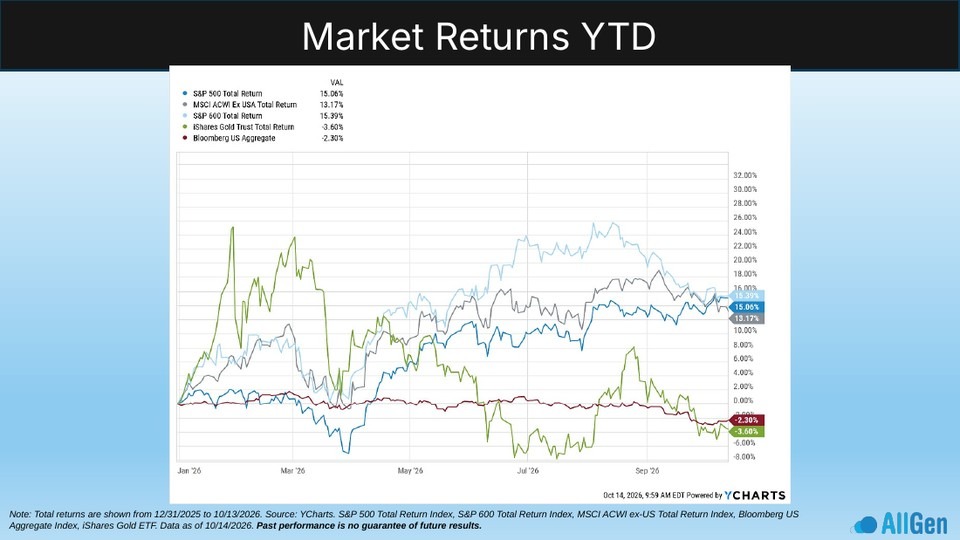
Caption: Leadership among stocks, bonds and gold changed several times during 2026.
These shifts reinforce an important principle: diversification is not simply about owning more investments. It is about owning investments that respond differently to changing economic conditions.
Why Oil and Energy Prices Are Driving Inflation
Oil and inflation was the top concern among webinar attendees, chosen by 44% in our live poll. Headline inflation was running at about 3.4%, while core inflation, which excludes food and energy, was about 2.4%. Without energy, inflation would be close to its longer-term average of about 2.5%.
Components of Consumer Price Inflation
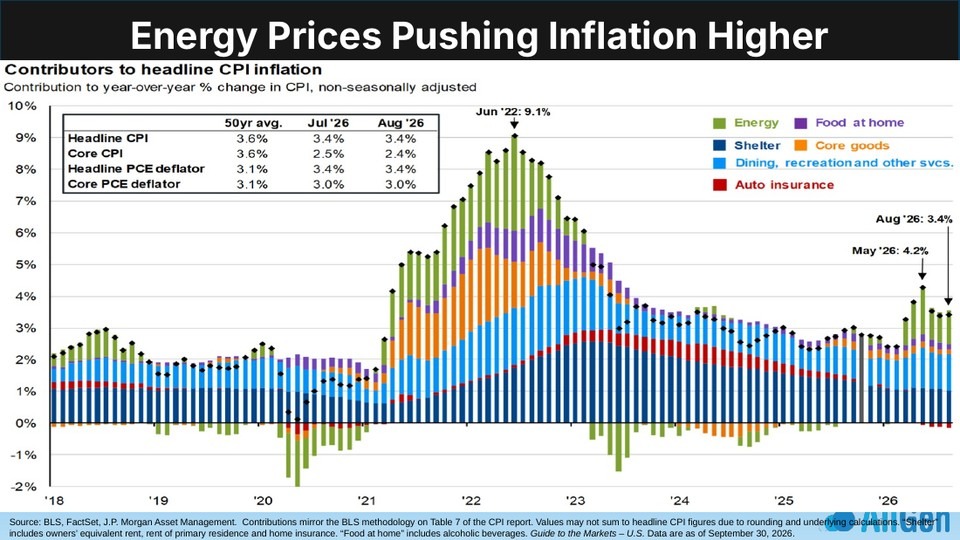
Caption: Energy has been the largest driver of the recent increase in headline inflation.
Oil (WTI crude) was about $55 to $65 a barrel before the conflict began, rose to about $115, fell back when shipping resumed through the Strait of Hormuz, then climbed again. It was about $95 at the time of the webinar.
Oil Prices and Geopolitical Conflict
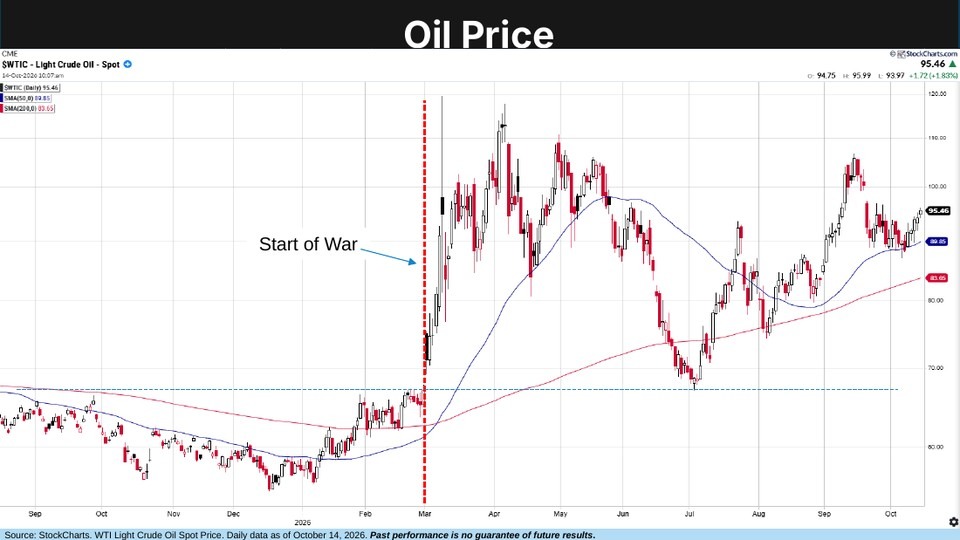
Caption: Oil prices have reacted quickly to changes in the conflict and to shipping through the Strait of Hormuz.
Oil matters for more than the price at the pump. Higher energy costs can affect:
- Transportation and shipping costs
- The price of other goods and services
- Inflation expectations
- Federal Reserve interest-rate decisions
If energy prices ease, inflation could return to more normal levels. If they stay high, they could spread into other prices.
What Does Low Consumer Confidence Tell Us
About the Market?
Consumer spending drives about two-thirds of the U.S. economy, and consumer confidence is near one of its lowest points on record. That may sound like bad news for stocks, but historically, the opposite has often been true. When confidence fell to levels like today’s, the S&P 500’s median return was about 19% one year later (positive 92% of the time) and about 53% three years later (positive 100% of the time).
Consumer Confidence and Future S&P 500 Returns
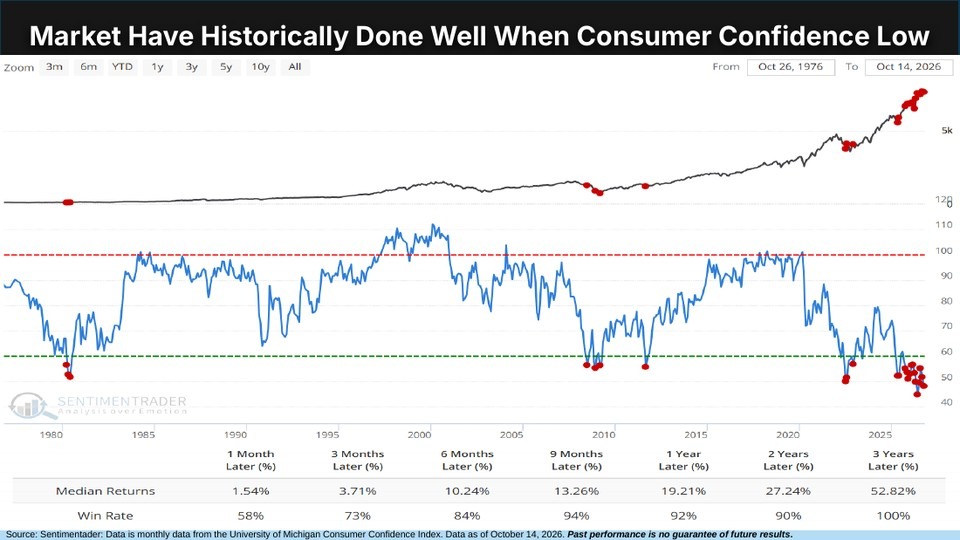
Caption: Periods of very low consumer confidence have historically been followed by strong market returns.
How consumers feel and how they act can also differ. Delinquencies on credit cards, auto loans and other consumer loans have been declining since about 2025. Past performance cannot predict future results, but your emotional reaction to the news may be a poor guide to what markets will do next.
Are U.S. Stocks Still Overvalued?
The S&P 500 started 2026 with a forward price-to-earnings (P/E) ratio above 20.5, well above its 30-year average of about 17.2. Valuations have since come down meaningfully. Unusually, that happened not because prices fell, but because earnings grew faster than prices.
U.S. Equity Valuations by Market Segment
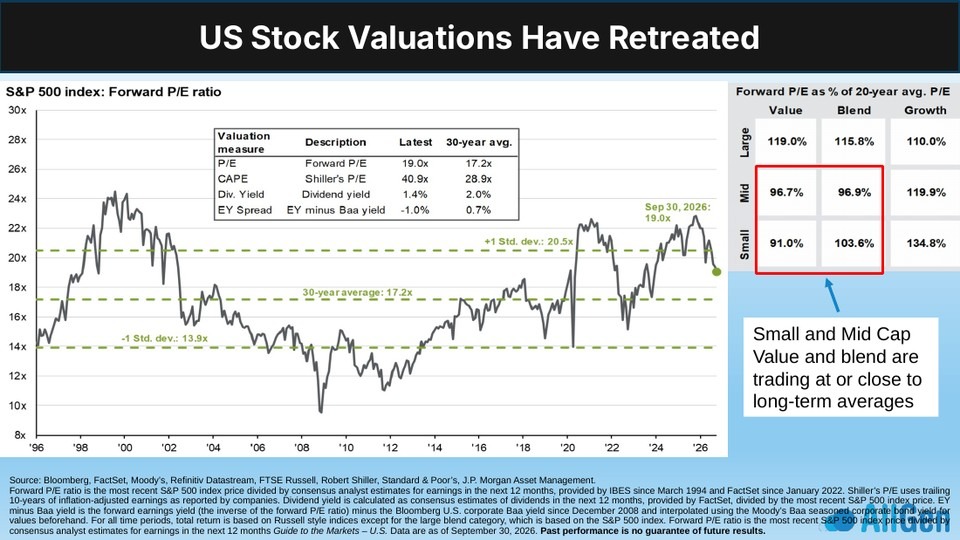
Caption: Valuations have come down this year, and smaller-company and value segments are trading below their 20-year averages.
Small- and mid-cap value stocks are trading below their 20-year averages. Large-cap growth, home to many AI and big tech companies, is still elevated but has come down from about 130% of its average last quarter. Emerging markets now trade well below their 20-year average. Investors may benefit from reviewing:
- Exposure to large-cap growth companies
- Small- and mid-cap allocations
- International and emerging-market exposure
How Are Earnings and Artificial Intelligence Supporting the Market?
Earnings have historically been one of the biggest drivers of stock prices. S&P 500 earnings have grown about 7.6% a year over the past 25 years. For 2026, analysts expect about 32%, more than four times the average, a pace seen only in the recoveries after 2008 and COVID.
Earnings Growth and Profit Margins
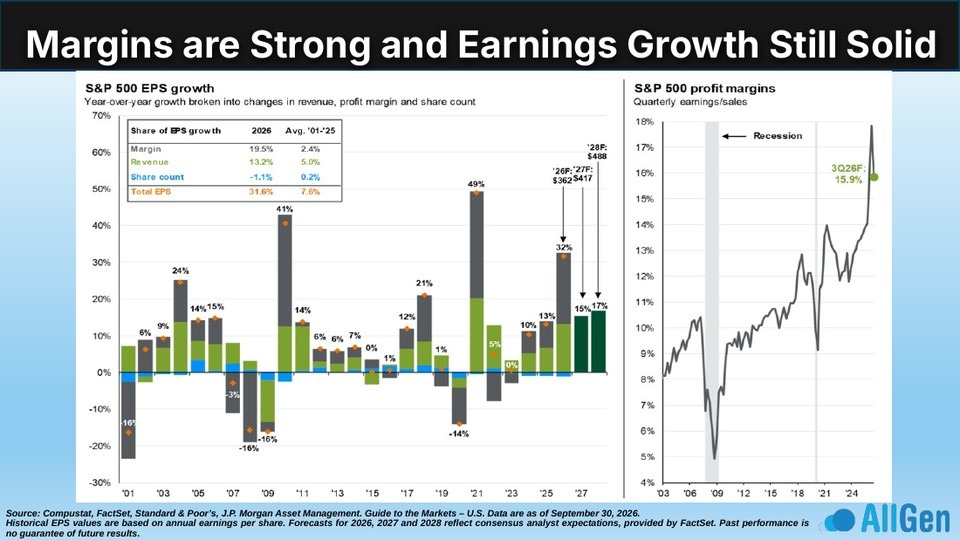
Caption: Earnings growth in 2026 is expected to be more than four times its 25-year average, and margins remain historically high.
Productivity gains from artificial intelligence are a major reason. Profit margins reached nearly 18% and remain high at about 15.9%. Meanwhile, the largest technology companies are spending even more than expected on AI data centers and infrastructure, which is helping drive the economy.
AI Capital Expenditures
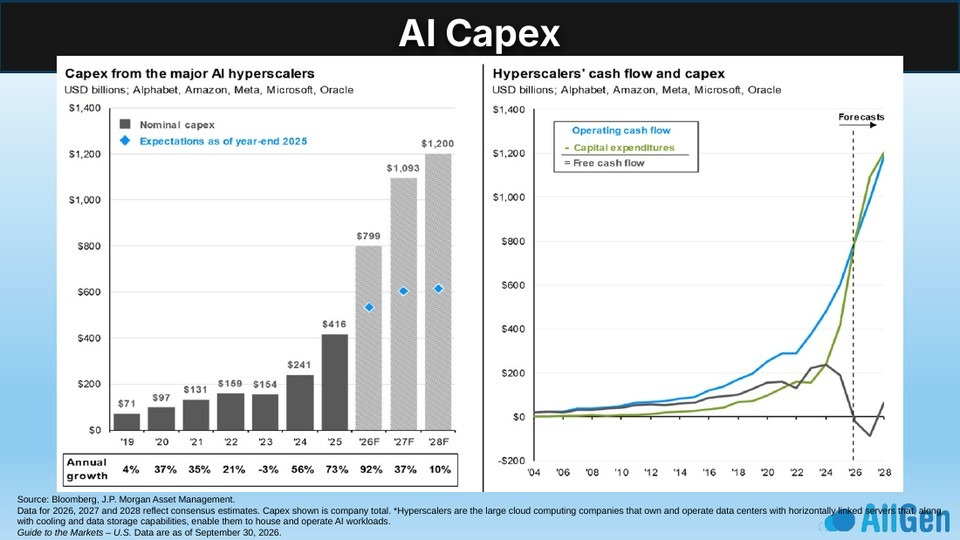
Caption: AI infrastructure spending by the largest technology companies has exceeded expectations.
Strong earnings combined with lower valuations could give the market more room to run, though faster-growing areas can also react sharply to disappointing results.
Could the Fourth Quarter Bring a Seasonal Tailwind?
Combining the one-year seasonal pattern, the four-year presidential cycle and the 10-year decennial cycle, markets historically pull back heading into October. This year’s pullback was much smaller than usual.
S&P 500 2026 Cyclical Chart
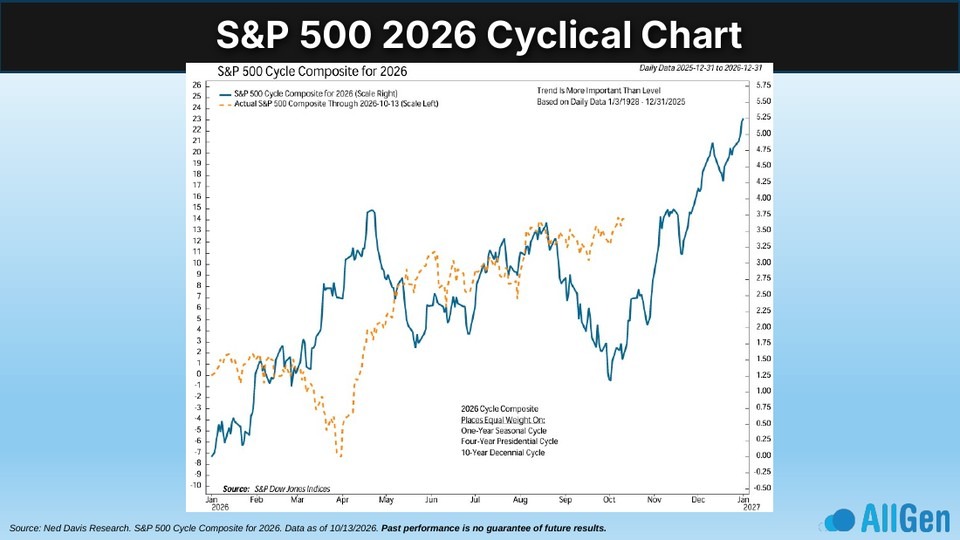
Caption: The November through January period has historically been the strongest seasonal stretch of the year.
November through January, often called the “Christmas rally,” has historically been the strongest stretch of the year. Seasonality is not a forecast; we use it as one piece of a weight-of-evidence approach.
What Do The Dollar, Gold and Commodities Mean for Diversification?
The U.S. dollar has broken out of a 14-month base, driven mainly by rising interest rates and higher oil prices. Gold usually moves in the opposite direction of the dollar, so it rallied early in the year and pulled back as the dollar strengthened. A stronger dollar has also weighed on international and emerging-market stocks.
Gold and the U.S. Dollar
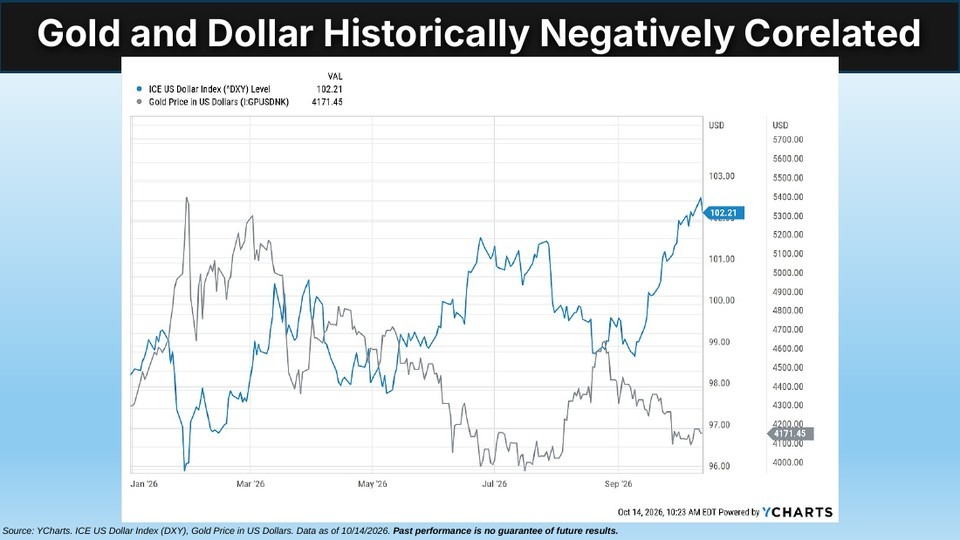
Caption: Gold has historically moved in the opposite direction of the dollar.
Over the long term, gold remains in an uptrend, and central banks continue to add it to their reserves. Commodities have outperformed the S&P 500 since about 2020 and tend to do well during inflation. Cryptocurrencies such as Bitcoin and Ethereum have broken out of their downtrends; they are not in our portfolios today, but we are monitoring them closely. Alternatives like these may help diversify a portfolio during periods of higher inflation or a changing dollar.
What is the Outlook for Interest Rates and Bonds?
Inflation led the Federal Reserve to raise rates for the first time since 2023, and markets see about a 93% to 94% chance of another increase by the December 9 meeting. The 30-year Treasury yield reached about 5.6%, a roughly 20-year high, and mortgage rates climbed to about 7.4%.
When rates rise, bond prices fall. Long-term Treasuries are down about 9.5% over the past year, compared with about 1.8% for the broad bond index. On the positive side, yields are far more attractive than five or 10 years ago, ranging from about 3.6% for money markets to about 5.7% for corporate bonds.
Year-to-Date Bond Performance and Yields
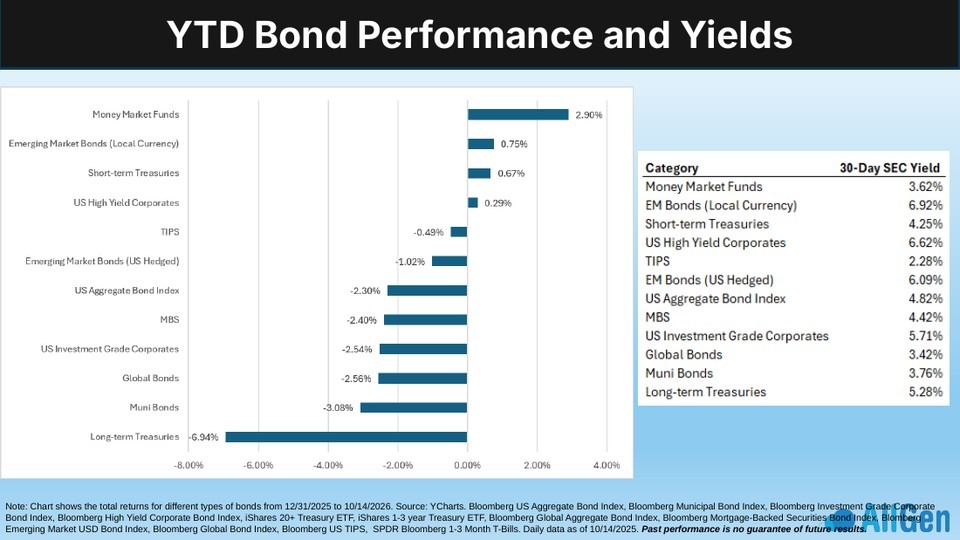
Caption: Longer-term bonds have struggled this year, while yields across the bond market have become more attractive.
Duration measures how sensitive bonds are to interest-rate changes. Earlier this year, we exited long-term Treasuries and shortened our bond portfolio’s duration to about 4.2, compared with about 5.8 for the benchmark, and added floating-rate Treasuries. This has helped our bond holdings hold up better than the overall bond index.
What Should Investors Do Before the End of 2026?
1. Review your financial plan
2. Complete year-end planning early
3. Avoid emotional market timing
Before changing your portfolio, return to your goals, time horizon and ability to withstand losses.
Investing with Discipline Through Uncertainty
The most successful investors stay focused on the long term, not the headlines of the day. A well-diversified, disciplined strategy built on risk management and thoughtfully selected, less-correlated assets is designed to help you stay on track through all kinds of markets.
At AllGen Financial, our goal is to help clients invest with confidence, manage risk thoughtfully and make decisions that support the life they want to live. Are your investments still aligned with your goals, risk tolerance and financial plan?
SCHEDULE A CONVERSATION
For more information, watch the full AllGen Financial’s Quarterly Market Update on October 15, 2026.
Frequently Asked Questions About the Q4 2026 Market Outlook
Is the stock market overvalued heading into 2027?
Valuations have come down in 2026 because earnings grew faster than prices. Large-cap growth stocks remain above average, while small-cap, mid-cap value and emerging-market stocks trade below their 20-year averages.
Will higher oil prices keep inflation elevated?
Energy is the largest driver of recent inflation, and core inflation is close to normal. If oil prices ease, inflation could come down; if they stay high, costs could spread to other goods and services.
What do rising interest rates mean for bonds?
Rising rates push bond prices down, especially for longer-term bonds, but they also mean bonds now pay more attractive income. Shorter-duration and floating-rate bonds have held up better.
Is gold still a good diversifier?
A stronger dollar has caused a short-term pullback, but gold remains in a long-term uptrend and central banks continue to buy it. A modest allocation can help diversify a portfolio over time.
What are emerging markets?
Emerging markets are faster-growing, developing economies outside the U.S., often summarized as BRICS: Brazil, Russia, India, China and South Africa.
What could help if inflation stays high and growth slows?
Commodities and energy stocks have historically held up during inflation, and consumer staples have tended to be resilient when growth slows. If inflation peaks and rates fall, bonds and gold have typically done well.
How should I invest for a young child?
A long-time horizon generally allows a more growth-oriented approach. For college savings, a 529 plan often starts mostly in stocks when a child is very young and shifts toward bonds as college approaches. The timeframe and objective for the savings typically drives the investment approach. It’s important to consult with an advisor for your specific circumstances.